Why Does My Knee Hurt When I Climb Stairs But Not on Flat Ground?

You walk through the supermarket without a second thought. Then you hit the first stair, and your knee has something to say. It's a frustrating and genuinely confusing pattern, because the pain seems so selective. The thing is that selectivity is actually useful information. Pain that shows up on stairs but nowhere else doesn't tell you much about what's going on inside the joint.
In this blog, we’ll explain why stairs can trigger knee pain when flat walking does not, what different pain patterns may mean, and when to seek professional care.
Why do stairs put so much more pressure on your knee
Flat walking is relatively easy on your knees. The joint moves through a modest range, the load stays manageable, and nothing demands too much from it at once. Stairs change both of those things simultaneously.
Unlike level walking, stair climbing repeatedly loads the knee while it is bent. The exact force varies with your body weight, speed, technique, and knee angle, but the combination of deeper bending and weight-bearing makes underlying irritation easier to feel.
The kneecap becomes a central player the moment you step up. As your knee bends, the kneecap moves through the groove at the end of your thigh bone while the surrounding muscles work to control the movement. For a knee dealing with irritation, weakness, or tracking issues, that added demand can bring symptoms to the surface even when walking on flat ground feels comfortable.
Going up vs. going down: why the pain pattern matters
Whether your knee protests going up, going down, or both gives you a meaningful clue about what's driving it.
Going up demands significant quad engagement and compresses the kneecap as it moves through its groove. Pain that's worse on the ascent often points to kneecap tracking issues or tendon irritation.
Going down is a different kind of challenge. Your muscles work eccentrically, meaning they lengthen under load to control your descent. That places a different, often greater, stress on the joint. Pain on the way down tends to point toward cartilage sensitivity, meniscus involvement, or joint wear that responds more to impact absorption than to muscle effort.
When both directions hurt equally, it often signals broader joint inflammation or a more established condition that warrants proper assessment.
The most common reasons your knee hurts on stairs
Several knee conditions can make stairs painful, and the location, timing, and type of discomfort can offer useful clues about the cause.
Patellofemoral pain syndrome (runner's knee)
This is one of the most frequent causes of stair-related knee pain. Patellofemoral pain syndrome commonly causes discomfort around or beneath the kneecap, particularly during activities that repeatedly load a bent knee.
The pain often feels like a dull ache at the front of the knee and may worsen when climbing stairs, squatting, running, or sitting with your knees bent for long periods. Overuse, sudden changes in activity, muscle weakness, and problems with kneecap movement may all contribute.
Knee osteoarthritis
When cartilage wears over time, the joint becomes more sensitive to positions that load it heavily. Stairs require both deep bending and significant force, which quickly exposes that sensitivity. Stiffness after rest, aching during or after stair use, and gradual worsening over time are the typical signs.
Patellar tendinitis
The patellar tendon connects the kneecap to the shinbone and absorbs significant force during stair climbing. When it becomes irritated, usually from repetitive activity or returning to movement after a break, you'll feel a specific tenderness just below the kneecap that flares with each step up.
IT band syndrome
The iliotibial band runs along the outer thigh and crosses the knee. When it tightens or becomes inflamed, the outer knee grows tender. The repeated bending and straightening of the stair mechanics consistently aggravate it. It's often mistaken for a joint problem when the source is actually the connective tissue alongside it.
Meniscus irritation
The menisci are the shock-absorbing pads inside your knee. Stairs load them with both compression and rotation. Pain with deep bending, a sense of catching or clicking, or discomfort along the inner or outer knee line can all point here.
Because these symptoms can overlap, pain that persists, worsens, or is accompanied by swelling, locking, or other signs should prompt evaluation by a healthcare professional for instability.
What your pain location is telling you
Front-of-knee pain, around or behind the kneecap, most often involves the kneecap itself or the patellar tendon. Pain along the inner or outer knee line points more toward ligament strain, IT band irritation, or meniscus involvement. Pain behind the knee is a different conversation entirely and usually warrants a direct assessment rather than self-management.


Hidden contributors most people overlook
Weak glutes are one of the most underappreciated contributors to knee pain. When the glutes aren't doing their job, the knee absorbs forces it was never designed to handle alone. Every stair step quietly compounds that pattern.
Hip tightness changes how the entire leg moves, altering the angle at which the knee bends and the kneecap's tracking. You may feel it in your knee without realizing the origin is higher up.
Flat feet or unsupportive footwear can rotate the lower leg inward, shifting load unevenly through the joint with every step. Sometimes, a simple change in footwear makes a noticeable difference before any other intervention.
Simple ways to support your knee right now

You do not necessarily have to avoid stairs entirely. Temporarily changing how you use them may reduce irritation while your knee settles. Leading with your stronger leg up and your affected leg down is a small mechanical adjustment that many people find helpful.
Gentle strengthening for the quads, glutes, and hip stabilizers builds the support system your knee needs to handle load more evenly. Straight-leg raises, mini squats, and clamshells can be low-impact starting points, although exercises should be adjusted if they increase your pain.
Daily habits matter too. Consistent sleep, balanced nutrition, appropriate movement, and adequate hydration all belong in a broader wellness routine. Readers interested in ingredient-based support can learn more about how turmeric fits into a daily routine and how organic white tea may support the body’s natural inflammatory balance, which is relevant to the broader joint inflammation mentioned earlier, when pain shows up in both directions.
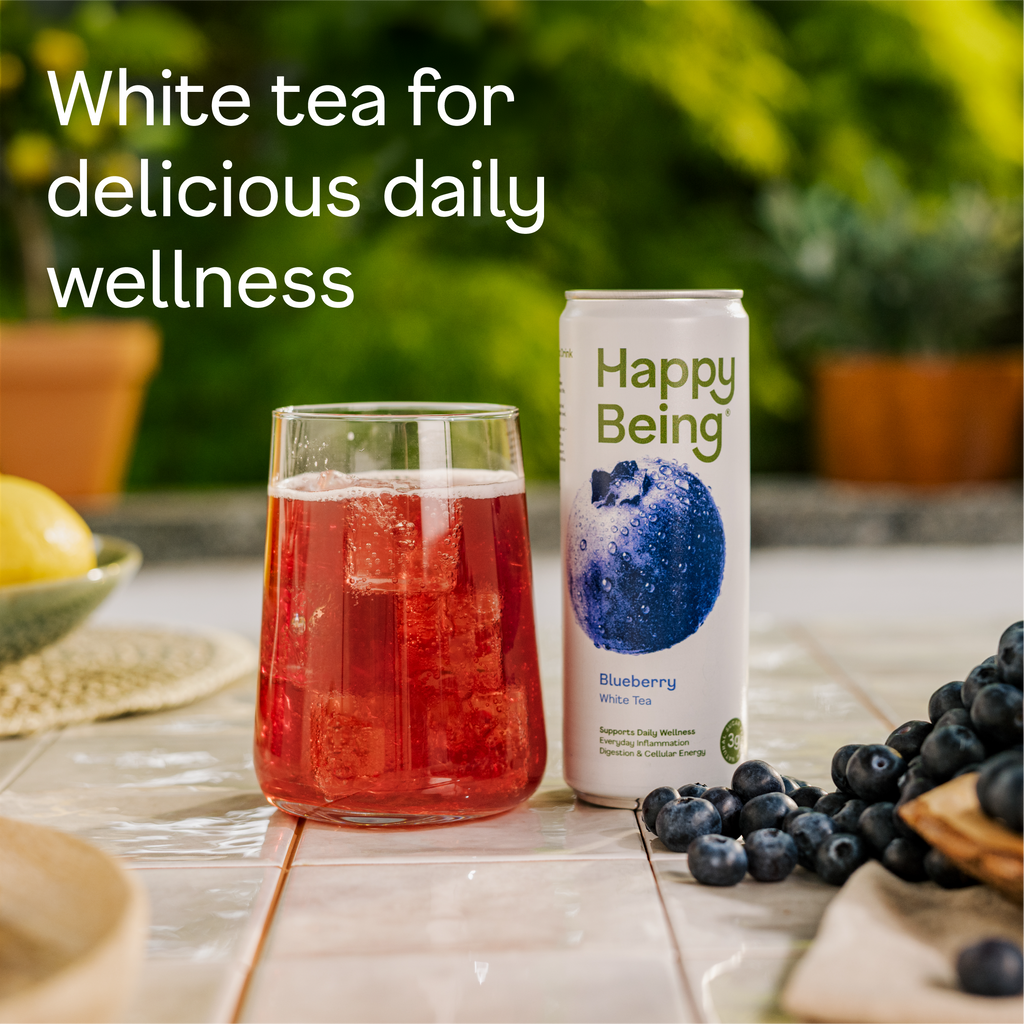
Elderberry, pterostilbene, and organic white tea also provide plant compounds involved in the broader relationship between polyphenols and oxidative stress. Happy Being combines these ingredients with Turmacin® turmeric extract and Vitamin C in a light, ready-to-drink can that fits naturally into a consistent wellness routine. It is not a treatment for knee pain, but it can complement everyday habits that support your overall health.
When to see a doctor about stair-related knee pain
Some signs are worth acting on promptly. Swelling after activity, a feeling of the knee locking or giving way, and sharp pain that does not ease with gentle movement deserve professional assessment rather than a wait-and-see approach.
Knee pain that does not improve within a few weeks, continues to worsen, or begins to limit everyday movement should also be evaluated by a healthcare professional. Seek more urgent care if you cannot put weight on the knee, it becomes badly swollen or deformed, or pain appears alongside fever, redness, and heat around the joint.
Most stair-related knee pain can be managed more effectively once the cause is understood. A proper assessment helps ensure that the advice, exercises, and activity changes you follow match what is actually happening inside the joint.
FAQs
Why does my knee hurt on stairs but not while walking?
Stairs require deeper knee bending and place more demand on the kneecap and surrounding tissues, which can reveal irritation that level walking does not.
Should I keep using stairs when my knee hurts?
You may be able to continue carefully if the pain is mild, but reduce activity if symptoms worsen, and avoid exercises that cause sharp or worsening pain.
When should I see a doctor about knee pain on stairs?
Seek an assessment if the pain persists, limits daily movement, or is accompanied by swelling, locking, instability, redness, or difficulty bearing weight.
Make Everyday Wellness Support Easier to Repeat

Knee pain needs the right assessment and movement plan, but the rest of your daily routine still matters. Happy Being combines organic white tea, Turmacin® turmeric extract, elderberry, pterostilbene, and Vitamin C also supports collagen production, and collagen is a structural component of the tendons and connective tissue, including the patellar tendon and IT band discussed above, that stairs place under repeated load.
Add thoughtfully chosen ingredients to the habits already supporting your body by exploring Happy Being’s white tea blends.
Disclaimer: This article is for general informational purposes only and is not a substitute for professional medical advice, diagnosis, or treatment. If you are experiencing persistent or severe knee pain, please consult a qualified healthcare provider.